Showing posts with label parenting. Show all posts

Thursday, July 17, 2014

Disney Dads

I've heard many other divorced parents talk about "Disney Dads" lately.  It seems to come up often and after reading a recent post regarding this topic I thought it would be helpful to address.

What is a Disney Dad?
A "Disney Parent" actually has a legal definition - "a noncustodial parent who indulges his or her child with gifts and good times during visitation and leaves most or all disciplinary responsibilities to the other parent."  It's usually used in reference to the father, since we are typically the non-custodial parent, but recently it's becoming more associated with mothers as well.

How Do We Become a Disney Dad?
There are two angles on this - one intentional, and one less intentional.  The intentional Disney Parent is one who deliberately treats the kids to all sorts of treats and privileges with the intent of undermining the custodial parent.  The less intentional, and more common, Disney Parent (and the one that will be addressed) is simply trying to have fun with their kids during the limited time they have available.  There are several factors behind this:
  • "Visitation" is what it's legally called when we non-custodial parents have our children. For many of us, having our time with our kids referred to as "visitation" changes how we look at that time.  After all, when you visit someone, you usually have different rules than when you're at home - later bed times, some fun excursions, etc.  Calling it "visitation" is harmful to the goal of parenting in many other ways, but it can definitely impact how we non-custodial parents look at our time with our children.
  • As non-custodial parents, we see our children with less frequency than do the custodial parents.  It's a simple fact.  Typically, this time is two weekends a month and maybe two weeknights a month.  That's not much time, from our perspective.  As a result, when we have our children, we naturally don't want that time occupied with homework, chores, discipline, rules, schedules, etc.  It's a rare time to be spent with our children and a time to be maximized.
  • In addition to not seeing them often, the other problem is when we see them - weekends and evenings.  What do even the most typical "nuclear families" do on weekends and evenings?  They typically play.  Trips or activities on the weekend, movie or video game time in the evening, and on weekend evenings, the kids probably get to stay up later than if it were a school night.  When this is the only time we see them, it's no surprise that the times are spent with weekend-type activities, later bed times, etc.
There are exceptions to every rule, including those above, but these situations are certainly the most typical encountered in divorce situations.  Additionally, these are not intended to be excuses for a parent being a Disney Parent, but only to help explain how one may end up being characterized as such.

How to Prevent Being a Disney Dad
Knowing now what a Disney Dad is and how one can be characterized as such, what do we do so we don't fall in to this pattern?  It takes being deliberate and being consistent in our job as a parent.   First, it must be understood by both parties that we non-custodial parents typically do not share the same circumstances as the custodial parent.  I never have my kids when they have school the next day, like their mother often experiences.  My kids are not here long enough to get in to habits of chores and schedules like they are with their mother.  But there are still important things we can do:
  • Be consistent.  You don't have to have the same schedules as at their mother's house (although it's helpful), but you need to be consistent.  When my kids are with me they have a fairly consistent bedtime.  We try to stick with that, whether it's summer weeknights or school year weekends.  Consistency is important for children.
  • Be involved.  Find out if your kids have homework that needs to be done while they're with you.  If their mom won't tell you, check with their teachers and their school.  Many schools have online calendars that can make you aware of these things.  Be in touch with their teachers so if something is due, you will know.  Know what's going on with them so you can continue those things at your place.  If a child plays sports, make a point to practice that sport with them.  If they play an instrument, look at getting one for them to use with you (if feasible) or have them bring it with them.
  • Encourage responsibility.  Even if their mother doesn't practice it, one responsibility of a parent is to teach their children responsibility.  When they're with you, that needs to be a focus.  Make sure they make their beds, clean their rooms, pick up after themselves, or do chores.  It doesn't need to be so much as to consume valuable time with them, but teaching your children is as important - if not more important - as playing with them.
  • Teach them.  As mentioned above, a key role of a parent is that of teacher.  Find life lessons in things.  Teach them a sport, a hobby, an instrument, or just encourage them to learn on their own. Play is good but lasts for only a time.  Teaching is better and lasts a lifetime.
  • Consistently discipline.  This is probably the hardest one to do given the limited time we have with them.  It's a horrible feeling when you tell your child that if they disobey that an activity will be canceled - and then they disobey.  As hard as it is, you must be consistent and follow through with what you said.  Children need discipline - not necessarily spanking or any specific punishment - but they need rules, boundaries, and to know that actions have consequences.  If they have certain rules at their mother's house then it's a good idea to be consistent with this when you can.  To say that mom's rules don't matter at dad's house is to essentially tell them that mom's rules don't matter, period, and that's not something you need to be teaching them.
Being a Disney Dad is still being dad, which is better than many children have, but you can be more than that.  You can be better.

Be the best dad you can be.  Be consistent.  Be involved.  Encourage responsibility.  Teach them.  And provide them with consistent discipline.  You'll still have plenty of time to play, be a family and have fun together.  But remember that you're a parent and your job - however difficult you feel the courts and/or your ex may make it - is to raise your children, not just entertain them.  And there can still be plenty of time for Disney World!

Thursday, July 3, 2014

Do Your Job

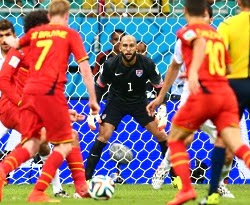
As a former soccer player and goalkeeper, I have been enjoying watching the 2014 World Cup.  Two performances stand out so far form this tournament - Guillermo Ochoa of Mexico, and Tim Howard of the United States.  In the first knockout game for the US, Belgium won 2-1 in extra time, but all the news was about Tim Howard and his World Cup record 16 saves - even though his team lost.  In spite of the defeat that knocked the United States team out of the 2014 World Cup, all the talk was of Tim Howard and his amazing performance in the tournament.

A game like the US had versus Belgium is a tough one for a goalkeeper to swallow.  On one hand, he turned in a record setting performance.  On the other hand, he gave up two goals and his team lost.  There's reason for pride and satisfaction, and there's reason for frustration.

This reminds me a lot of divorce and the transition to being a single parent.  I think it's fair to say that the break-up of a marriage can be seen as a loss or a failure.  It's frustrating, to say the least.  But it opens up the door to the awareness of all the little victories that you didn't know you were capable of - getting the kids out the door and to school on time (properly dressed, and with lunches and homework!), getting them to a doctor appointment, diagnosing and helping them get rid of an ailment, teaching them a new skill, etc.  Dads aren't always known for these things - but we're fully capable of achieving them.

As fathers, our instinct is to protect and teach our children.  We're the keepers of their hearts, their minds, and their bodies, in many ways - especially for those of us with daughters.  We cannot dwell on the things that would otherwise be perceived as failures.  We can't stop all the bad or negative things.  But part of our job - and two of our goals - is to do our best to (1) stop anything that may hurt or interfere with our children, and (2) set them up for success in the present and the future - just as a goalkeeper is tasked with keeping the opponent from scoring and setting up his team for the best possible chance at a goal in the way that he distributes the ball downfield.

You can look back at your marriage and life and see a failure.  It's easy to do - especially when you have to fill in that line "Marital Status" on so many forms.  Or you can look at each little victory you have as a father and focus on how many saves you have made and all the times you have set your kids up for success.  You won't stop everything, but do your best and never stop making the effort.

A big difference between a soccer game and the divorced life is that the loss happens at the beginning and the saves follow.  We can give up when we find out the marriage is over and leave our kids undefended and without assistance.  Or we can buckle down and realize that our job still exists and that there is a game within the game.  A failed marriage - or failure as a husband - is not synonymous with a failed parent, or failure as a father.

Watch these elite goalkeepers as they do their job.  They defend their goal at all costs.  They challenge the attackers.  They make it their responsibility to make sure every throw or kick has maximum potential to set up their teammates for success.  They put themselves at risk and injury is not uncommon.  They do it because that's their job - even when their team may seem hopelessly down and even if the rest of their team is not performing to expectations.  Look at them and be that kind of father.
  • Be reliable and be ready
  • Defend your children at all costs.  
  • Challenge anything that threatens them.  
  • Do everything you can do to set them up for success both today and later in life.  
It's your job - don't stop, do it well, and do it for your children.  They need you.  Be there for them.

Wednesday, April 9, 2014

All Apologies

As a single dad, I like to think that there's nothing I can't do.  I can be the dad I want to be and I can do it without any help.  I can be Superdad.  I like to think that.  It doesn't always work out that way.

This winter I took my children snow skiing for the first time.  I figured I could teach the kids myself.  I taught them to swing and to ride their bikes without training wheels, after all.

We began on the bunny slope with me trying to ski beside them, but that just didn't work, so I took off my skis and would run beside or behind them, not too unlike it was when I taught them to ride their bikes.  One would ski down while the other would ride the people-mover up.  And I would run up the hill in my ski boots to help the next one down.  Those boots were not made for running, but that's just what they did.  We ended our time on the bunny slope after my daughter, unable to stop, ran in to another learner and injured her a bit - just enough that the adult with that person was very mad at my daughter.  So I got mad at my daughter.  I didn't want people to think that I didn't take slope safety seriously.  After crashing in to someone and having me yell at her my daughter's self-confidence was fairly well shattered.  I figured that would be a good time to take a lunch break.  I apologized to her at lunch, but she was less than enthusiastic when we went out to take the chairlift up to the top of the easy slope where we had more room than on the bunny slope.

We made it off of the lift and I tried, first, to help my daughter down.  She did well and skied down to the lift ok, as did my son.  But the lift line had a downward slope.  Neither of my kids knew how to "stand" in the snow without skiing.  One slid left, the other right, both crying "Daddy!" while I tried to tell them what to do to keep from sliding and running in to more people.  It didn't work and I lost my temper.  I got mad at both of them, probably created a bit of a scene, and had to walk away for a moment.

I was crushed.  I knew what I had done.  I knew I had set a bad example, embarrassed myself, let down my kids, and, in short, failed.  And I couldn't undo any of it.  This doesn't happen to Superdad.  I'm supposed to be able to do it all.  But I couldn't.  I figured things out after this and later apologized to both children individually.  We ended up having a great time

Here's the point: our children learn from us - for better or for worse.  When we get mad, they learn how to get mad.  But when we apologize, they learn to apologize.  They need to see us make mistakes - which works well, because I make more than I'd like - and they need to see how we handle it.  When we fail, they need to see us recover.  They need to learn humility from us.  They need to learn selflessness from us.  They also need to know that they don't have to be able to do it all.  It's okay to fail.  The only way to never fail is to never try, and we don't really have that option as parents - and particularly as single parents.

Don't be too proud to apologize to your child.  Don't be too proud to let them know you made a mistake.  When we apologize and make mistakes, they learn that it's okay to do both.  Superman knows his limits and weaknesses.  Superdad needs to do the same - though our limits and weaknesses are far more numerous!

My children both rallied around me in the end and I was proud of them.  They both learned to ski.  They both did great and have never mentioned my momentary lapse of reason.  While they may have seen a bad example of how to handle frustration, they saw a good example of how to handle failure and how to own up to your behavior and mistakes.

Be real with your children.  Be humble.  Be selfless and apologize when necessary.  If they don't see it from us, they may never learn it from anyone else.

Monday, April 7, 2014

Quantity Time vs Quality Time

Before my divorce, I was told many times to place greater emphasis on quality time than on quantity time.  As a married father, quantity time is plenty - you see your kids in the morning, in the evening, and every weekend.  Often this time is squandered by all the distractions of life.  As a result, there is the emphasis on creating quality time instead.

But after the divorce, things changed.  I didn't see my kids every day.  I didn't see them in the mornings or evenings.  I didn't see them most weekends.  And while I made my best effort to make quality time of the time we did have together, children need more.  While I had no problem making quality time when they were with me, I had to change my mindset and make a conscious effort to create quantity time during those many times when they were not with me.  I now schedule it in to my day.

It doesn't take much.  Quantity time can consist of phone calls in the evening.  For example, I call my kids every weekday.  If they want to talk, we talk.  If they don't, I tell them that I love them, to be a good boy/girl for their mother, and don't make them do anything they don't want to do.  I have made the ten-hour round trip drive to see my daughter in a one hour dance recital (her part constituting perhaps 15 minutes of that) where I only got to see her for a few minutes afterward, and none of that time was one-on-one.  I've made the same drive for two or three hours with them on a holiday.

For those divorced dads that live near their children, go to every event you can.  Even if you don't get to spend any quality time with your child.  Go to every sports event, school event, church event, and anything else you can.  Let them know you're there and that you care.  Let them hear your voice and see your smile.  If you can Email, Skype or text your kids - do it.  Do whatever you can.  Even if it's simple things like "I'm thinking of you!" or "Have a good day!"  Conversation doesn't have to be substantive or even present at all if it's not feasible.  Don't make a scene.  Just be seen.

Life changes after divorce.  Don't let your children be visitors - they're not.  They're your children and you're their father.  Give them all the quantity time you can when you don't have them.  And give them all the quality time you can when you have them.  They need everything we can give them.