Tuesday, July 22, 2014

American Ninja Father

My kids and I enjoy watching American Ninja Warrior together.  If you're not familiar with it, it's a high-powered obstacle course with stations that test the contestant's strength and agility.  One reason I enjoy watching it with my kids (a 9 year old boy and a 12 year old girl) is that it teaches valuable life lessons and also entertains.  As fathers, I believe we're to be teachers, and it's a win any time you can teach your kids and be entertained at the same time.

One Shot
Each contestant gets one shot at the course.  There is no second chance - not until next year.  If you fall, if you slip, if you are injured - that's it.  "Almost" doesn't count.  What counts is finishing or getting the farthest the fastest.

For us divorced dads, we've obviously stumbled in some way in the past.  It may or may not have been our fault, but it doesn't change the outcome.  We do get a second chance, but not without more work and risk.  There is very little room for error in being a parent and the stakes are high.  When we fail, we have to learn more, be more patient, try harder, and focus more intently.

For our children, they will make mistakes.  They need to know that while there are second chances, there are also consequences.  If your mistake was an accident or not - it doesn't matter.  It was your fault or was someone else's - it doesn't matter.  Even if you tried really hard - it doesn't matter.  The consequences are the same.  There are additional opportunities, but they need to learn that these momentary failures pave the road to long term success.

Unpredictability
While each course in American Ninja Warrior features some familiar elements, they feature new elements as well.  The contestants never know what their course will look like until they actually arrive to compete.  They may have trained specifically for elements that aren't there.  And they may have never considered, much less trained for, elements that are there

For us divorced dads, clearly we have encountered elements in life for which we never planned.  There were also things for which we thought we had planned, but didn't do well enough.  The lesson for us is that we can't predict the lives of us or our children.  We have to be prepared with certain principles of life, relationships and faith.  We have to recognize our weaknesses and strengthen them, focus on our strengths as much as possible, and exercise our best judgement at all times in order to keep moving.

For our children, the lessons are much the same.  Life is not predictable.  They must understand that they can't be good at everything, but they have to be prepared to handle anything.  They need to learn to use their strengths and to recognize and allow for their weaknesses.  Most of all, they need to learn how to exercise good judgement in all circumstances.  One of the lessons American Ninja Warrior teaches is that the best results are obtained when both technique and strength are used together wisely.

No Special Treatment
Everyone runs the same course and is held to the same standards - male, female, old, young, muscular, trim, short, tall, large, small, veteran, or rookie.  There are no exceptions, no accommodations, and there is no special treatment.

We divorced dads have faced some obstacles that many fathers haven't.  But it ultimately doesn't matter.  We're still parents and we're still working to raise our children, just the same as a married father.  Our marital status doesn't matter, nor does our income, the frustrations of divorce, or anything else.  A father is a father, and raising a child is raising a child.  Anything else is an excuse that can limit our ability to be the best father we can be to our children.

Our children will learn that there are exceptions - girls play on different teams, sports are divided by ages, etc.  But once they enter the real world, that all ends.  You can't count on anyone to give you a break because of who you are or are not.  Those who do not expect any special treatment will go the farthest and do the best.  Our children need to learn that what may be perceived as weaknesses don't matter - life places the same demands on all.  They need to learn that things that may be perceived as weaknesses that would limit them should be treated as challenges to be overcome and that will subsequently strengthen them.  They can learn by watching us overcome the obstacles of divorce and single parenting.  Set the example and be the best role model they have for overcoming.

No Comparison
Watch the show and you'll see that you can't judge a book by its cover.  The most muscular men do not always do the best.  Many times it's those who wouldn't draw a second look in the gym who excel.  The smaller women may also go farther than the larger men.  Everyone runs the same course.  It's the results that matter - not how you look or what people think about you.

For us divorced dads, it's easy to get caught up comparing ourselves with others - those who seem happily married, those who seem more financially secure, those who have good relationships with their ex.  First, what we see is not always what is.  Sometimes the one who seems the happiest may in fact have a non-existent relationship with his children.  The man who seems most financially secure may be so income-driven that he doesn't take the time with his children that they need.  Second, other people simply don't matter when it comes to how we perform as a father.  All that matters is our performance and how well we do.  Our kids may have a step-parent, we are still the only father our children will have and we need to conduct ourselves at all times with that in mind.

For our children, the lessons are the same.  How the other children appear simply doesn't matter when it comes to how our children perform.  Our kids needs to learn that their greatest challenge comes from themselves - having confidence in themselves, challenging themselves, being happy with themselves.  There will always be a child that is better than them at something.  We need to teach our children that their greatest and only goal is to be the best person they can be, and the only measure that matters is against who they were yesterday.


American Ninja Warrior may not be everyone's preference for television, but the lessons to be learned - by both our children and by us - are significant.  Certainly it's not a perfect metaphor for life - life is unfair, there is favoritism, and people cheat to get ahead.  But you can't dwell on those things.  The core lessons still apply.  Be their teacher.  Be their example and role model.  Don't coddle them - challenge them.  Show them by example how to compete and how to overcome.  You only get one shot.  Do it well.


Andrew Karsen exercises with his son and talks about the struggles of life


Improvisation and creativity, overcoming adversity, and never quitting:


The first female to qualify for the finals, 5'0" 100lb Kacy Catanzaro:

Thursday, July 17, 2014

Disney Dads

I've heard many other divorced parents talk about "Disney Dads" lately.  It seems to come up often and after reading a recent post regarding this topic I thought it would be helpful to address.

What is a Disney Dad?
A "Disney Parent" actually has a legal definition - "a noncustodial parent who indulges his or her child with gifts and good times during visitation and leaves most or all disciplinary responsibilities to the other parent."  It's usually used in reference to the father, since we are typically the non-custodial parent, but recently it's becoming more associated with mothers as well.

How Do We Become a Disney Dad?
There are two angles on this - one intentional, and one less intentional.  The intentional Disney Parent is one who deliberately treats the kids to all sorts of treats and privileges with the intent of undermining the custodial parent.  The less intentional, and more common, Disney Parent (and the one that will be addressed) is simply trying to have fun with their kids during the limited time they have available.  There are several factors behind this:
  • "Visitation" is what it's legally called when we non-custodial parents have our children. For many of us, having our time with our kids referred to as "visitation" changes how we look at that time.  After all, when you visit someone, you usually have different rules than when you're at home - later bed times, some fun excursions, etc.  Calling it "visitation" is harmful to the goal of parenting in many other ways, but it can definitely impact how we non-custodial parents look at our time with our children.
  • As non-custodial parents, we see our children with less frequency than do the custodial parents.  It's a simple fact.  Typically, this time is two weekends a month and maybe two weeknights a month.  That's not much time, from our perspective.  As a result, when we have our children, we naturally don't want that time occupied with homework, chores, discipline, rules, schedules, etc.  It's a rare time to be spent with our children and a time to be maximized.
  • In addition to not seeing them often, the other problem is when we see them - weekends and evenings.  What do even the most typical "nuclear families" do on weekends and evenings?  They typically play.  Trips or activities on the weekend, movie or video game time in the evening, and on weekend evenings, the kids probably get to stay up later than if it were a school night.  When this is the only time we see them, it's no surprise that the times are spent with weekend-type activities, later bed times, etc.
There are exceptions to every rule, including those above, but these situations are certainly the most typical encountered in divorce situations.  Additionally, these are not intended to be excuses for a parent being a Disney Parent, but only to help explain how one may end up being characterized as such.

How to Prevent Being a Disney Dad
Knowing now what a Disney Dad is and how one can be characterized as such, what do we do so we don't fall in to this pattern?  It takes being deliberate and being consistent in our job as a parent.   First, it must be understood by both parties that we non-custodial parents typically do not share the same circumstances as the custodial parent.  I never have my kids when they have school the next day, like their mother often experiences.  My kids are not here long enough to get in to habits of chores and schedules like they are with their mother.  But there are still important things we can do:
  • Be consistent.  You don't have to have the same schedules as at their mother's house (although it's helpful), but you need to be consistent.  When my kids are with me they have a fairly consistent bedtime.  We try to stick with that, whether it's summer weeknights or school year weekends.  Consistency is important for children.
  • Be involved.  Find out if your kids have homework that needs to be done while they're with you.  If their mom won't tell you, check with their teachers and their school.  Many schools have online calendars that can make you aware of these things.  Be in touch with their teachers so if something is due, you will know.  Know what's going on with them so you can continue those things at your place.  If a child plays sports, make a point to practice that sport with them.  If they play an instrument, look at getting one for them to use with you (if feasible) or have them bring it with them.
  • Encourage responsibility.  Even if their mother doesn't practice it, one responsibility of a parent is to teach their children responsibility.  When they're with you, that needs to be a focus.  Make sure they make their beds, clean their rooms, pick up after themselves, or do chores.  It doesn't need to be so much as to consume valuable time with them, but teaching your children is as important - if not more important - as playing with them.
  • Teach them.  As mentioned above, a key role of a parent is that of teacher.  Find life lessons in things.  Teach them a sport, a hobby, an instrument, or just encourage them to learn on their own. Play is good but lasts for only a time.  Teaching is better and lasts a lifetime.
  • Consistently discipline.  This is probably the hardest one to do given the limited time we have with them.  It's a horrible feeling when you tell your child that if they disobey that an activity will be canceled - and then they disobey.  As hard as it is, you must be consistent and follow through with what you said.  Children need discipline - not necessarily spanking or any specific punishment - but they need rules, boundaries, and to know that actions have consequences.  If they have certain rules at their mother's house then it's a good idea to be consistent with this when you can.  To say that mom's rules don't matter at dad's house is to essentially tell them that mom's rules don't matter, period, and that's not something you need to be teaching them.
Being a Disney Dad is still being dad, which is better than many children have, but you can be more than that.  You can be better.

Be the best dad you can be.  Be consistent.  Be involved.  Encourage responsibility.  Teach them.  And provide them with consistent discipline.  You'll still have plenty of time to play, be a family and have fun together.  But remember that you're a parent and your job - however difficult you feel the courts and/or your ex may make it - is to raise your children, not just entertain them.  And there can still be plenty of time for Disney World!

Friday, July 11, 2014

Elephants and Exes

What do you do when your kids come to you and tell you that their mother was telling them something about you that you knew was false?  Do you tell them mommy lied?  Do you change the subject?  Do you tell your own lie or something negative about her?  As divorced people, it's not uncommon to find ourselves in this situation.  The one thing you do not need to do is belittle their other parent.  You should never tell your children anything deliberately negative or critical of their other parent.  Obviously the two of you didn't get along and you're now exes, but to your children, she is still mommy and you are still daddy.

So what to do - how do you handle this?  I have had several moments where I had to address a situation such as this, but with their mom saying all these bad things about their dad, the last thing I wanted to do was be the dad saying more bad things about their mom.  That doesn't help the children at all.  But I was reminded of a fable I'd heard years before about the blind men and an elephant:
Six blind men were asked by their king to determine what an elephant looked like by feeling different parts of the elephant's body. The blind man who felt a leg said the elephant was like a pillar; the one who felt the tail said  the elephant was like a rope; the one who felt the trunk said the elephant was like a tree branch; the one who felt the ear said the elephant was like a hand fan; the one who felt the belly said the elephant was like a wall; and the one who felt the tusk said the elephant was like a solid pipe.  The king explained to them:  All of you are right. The reason every one of you is telling it differently is because each one of you experienced a different part of the elephant. The elephant actually has all these features.
Remembering this story, I sat my two children down on the couch one evening after they'd been asking questions about things their mother had said about me that I knew to be untrue.  I blindfolded both and, not having an elephant handy, grabbed the only thing I could find that I thought might suffice - a shampoo bottle: thick at the bottom, and narrow at the top.  I held it by the top for my daughter and let her feel the bottom.  Then I held it by the bottom and let my son feel the top.  When I asked them to describe it, one said it was thick and kind of big, the other said it was narrow and small.  I removed their blindfolds and let them see what it was they were feeling.  Taking a page from the fable, I told them something like this:
Sometimes mommy and daddy see, hear or remember things differently.  I see or remember it one way, and mommy sees or remembers it another way.  It doesn't mean either one of us is wrong, it just means that we're different and we may see, hear or remember things differently sometimes, just like the two of you thought differently about this bottle.
Being young at the time, probably 7 and 9 or so, this was enough to convince them that perhaps what mommy was saying about daddy, while clearly not accurate, wasn't necessarily a lie, and we were able to move on to other things.  In fact, I haven't really had to address that question since then.

The short story is this - too often we get in competitions with our ex to see who can tell the kids the most garbage about their other parent.  Perhaps we hope that we can make ourselves look better than the other person in the eyes of our children.  But all they see is both parents tearing each other down.  They don't see right or wrong, or who won and who lost - and they don't care.  They only see conflict between the two people who mean the most to them.  Our goal should be to BE the better person, not to tear the other down to be a lesser person.  The children will learn the truth about both of us in their own time and in their own way.  Let them know that you had their best interests at heart.  And who knows, maybe you'll get lucky and the local zoo will let you borrow their elephant!

Wednesday, July 9, 2014

Setting the Example

I have two young children.  Recently, they both were in trouble for fighting with each other (as siblings do) and I had to talk to them.  Without fail, in situations such as this, my boy says "but she..." and my daughter says "but he..." and neither of them hears what I'm saying to them because they're too focused on their sibling.  I tell them "I'm talking to you about you, not to you about your brother/sister."  They reply with "Well he/she..." and I respond that "If you do that to her will that make things better or worse?  If you hit her because she hit you, then what's she going to do back to you?"  They begin to understand where I'm going, though they don't like what they're hearing.

"I can't tell you how to guarantee that they'll be nice to you," I tell them, "but I can pretty much guarantee that if you're mean to him then he'll be mean to you.  But if you're nice to him, then he's more likely to be nice to you.  And if he's not, then he's the one getting in trouble instead of you AND him."  They don't like this, but hopefully one day they'll understand and put it into practice.  But that conversation resonated with me in a way I didn't expect.

Children learn primarily from their parents and their home life, and secondarily from school and other social situations.  I can't control what happens at school or elsewhere, and I can't control what happens at their mom's place.  The closest I can come to controlling my kids is showing them that I can control myself and to practice in my life what I preach to their lives.

For us divorced parents, our marriages are over.  But for our kids, she will forever be mommy and he will forever be daddy.  You can't control your ex, but you can control how you treat them and respond to them.  Your children see this, learn from it, and to varying degrees they will repeat it.

Our human instinct is to return harm for harm, which makes things progressively worse.  I can't guarantee that your ex will respond better when you respond with kindness and civility, but at least you won't be the one on the hook for the children learning that behavior.  They will see how you respond and they will learn from it.

It's a frustrating fact of divorced parenting that being a good parent means we also need to be a good co-parent.  As I've told my kids, "you don't have to like him/her - but you at least have to act like you do."  You need to at least be civil with your ex for the sake of your children, and it does not excuse you from that responsibility even if the other parent is hostile.  Even when the kids aren't around we need to be mindful of this, for how we treat our ex in private will influence at least in part how we treat them around the kids.  One way or another, the children will know how we treat their other parent, and it will influence them.

Be the better person.  Be the better parent.  And be as consistent in it as possible.  It's not easy, but it's worth it for the sake of our children.  They are watching, listening, and learning.

Thursday, July 3, 2014

Do Your Job

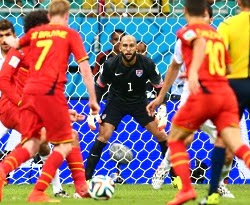
As a former soccer player and goalkeeper, I have been enjoying watching the 2014 World Cup.  Two performances stand out so far form this tournament - Guillermo Ochoa of Mexico, and Tim Howard of the United States.  In the first knockout game for the US, Belgium won 2-1 in extra time, but all the news was about Tim Howard and his World Cup record 16 saves - even though his team lost.  In spite of the defeat that knocked the United States team out of the 2014 World Cup, all the talk was of Tim Howard and his amazing performance in the tournament.

A game like the US had versus Belgium is a tough one for a goalkeeper to swallow.  On one hand, he turned in a record setting performance.  On the other hand, he gave up two goals and his team lost.  There's reason for pride and satisfaction, and there's reason for frustration.

This reminds me a lot of divorce and the transition to being a single parent.  I think it's fair to say that the break-up of a marriage can be seen as a loss or a failure.  It's frustrating, to say the least.  But it opens up the door to the awareness of all the little victories that you didn't know you were capable of - getting the kids out the door and to school on time (properly dressed, and with lunches and homework!), getting them to a doctor appointment, diagnosing and helping them get rid of an ailment, teaching them a new skill, etc.  Dads aren't always known for these things - but we're fully capable of achieving them.

As fathers, our instinct is to protect and teach our children.  We're the keepers of their hearts, their minds, and their bodies, in many ways - especially for those of us with daughters.  We cannot dwell on the things that would otherwise be perceived as failures.  We can't stop all the bad or negative things.  But part of our job - and two of our goals - is to do our best to (1) stop anything that may hurt or interfere with our children, and (2) set them up for success in the present and the future - just as a goalkeeper is tasked with keeping the opponent from scoring and setting up his team for the best possible chance at a goal in the way that he distributes the ball downfield.

You can look back at your marriage and life and see a failure.  It's easy to do - especially when you have to fill in that line "Marital Status" on so many forms.  Or you can look at each little victory you have as a father and focus on how many saves you have made and all the times you have set your kids up for success.  You won't stop everything, but do your best and never stop making the effort.

A big difference between a soccer game and the divorced life is that the loss happens at the beginning and the saves follow.  We can give up when we find out the marriage is over and leave our kids undefended and without assistance.  Or we can buckle down and realize that our job still exists and that there is a game within the game.  A failed marriage - or failure as a husband - is not synonymous with a failed parent, or failure as a father.

Watch these elite goalkeepers as they do their job.  They defend their goal at all costs.  They challenge the attackers.  They make it their responsibility to make sure every throw or kick has maximum potential to set up their teammates for success.  They put themselves at risk and injury is not uncommon.  They do it because that's their job - even when their team may seem hopelessly down and even if the rest of their team is not performing to expectations.  Look at them and be that kind of father.
  • Be reliable and be ready
  • Defend your children at all costs.  
  • Challenge anything that threatens them.  
  • Do everything you can do to set them up for success both today and later in life.  
It's your job - don't stop, do it well, and do it for your children.  They need you.  Be there for them.

Friday, June 6, 2014

Fight for Your Children

In general, we men are fighters.  We're fixers.  We see a problem, we fix it.  We have a struggle, we fight through it.  But divorce is different.  We can't fix it.  We can't fight it - especially not literally.  In many cases we lose our kids, we lose a great deal of our money, we lose a measure of pride, and the losses may continue in other areas.  For those of us who try to be good dads to our kids even after the divorce, the strain is difficult and many men simply find it easier to give up.  It may be easier, but it's the worst thing we can do for our children.

As I write this, it is June 6, 2014 - the 70th anniversary of D-Day in France in 1944.  I read a lot of World War 2 history and I've drawn much encouragement and motivation from the struggles of the allied forces during that time.  In 1941/1942, Britain was being pounded daily by German air raids and they lived in fear of invasion.  The United States had suffered the devastating defeat at Pearl Harbor where much of our Pacific Fleet was destroyed.  The next year, 1942, we lost almost all of the Pacific - Singapore, the Philippines, Wake Island, Guam, and much more.  Germany was close to conquering the Soviet Union and had occupied or conquered much of Europe and North Africa.  We were outmanned, outgunned, inexperienced, and had minimal capabilities to get our forces to the far off places where they were needed.  Everything was against us.

But we kept fighting.  We kept trying.  We didn't give up.  Soon, we took footholds in the Pacific.  Our navy began turning the tide at the Battle of Midway in June, 1942.   The allied armies began pushing the Germans back in North Africa.  We moved forward.  It was not without great cost, but positive progress was made toward our goals.

In our fight as divorced dads, the court hearings and other formalities that leave us without our kids, with large financial burdens and perhaps legal fees, senses of loss and frustration and new feelings of helplessness, we feel defeated.  The failure of our marriage may be fresh on our minds.  We feel like we cannot be successful or competent fathers.  But we can.  We just have to keep moving forward.  Two quotes from the D-Day invasion come to mind:

"There are only two kinds of people who are staying on this beach: those who are already dead and those that are gonna die. Now get off your butts...."  Col George A Taylor

"As best I can figure it, we’re on the wrong beach....  They landed us about a mile and a quarter south of where we were supposed to land.  We should be up there.  We’re starting the war from right here.  Head inland.  We’re going inland."  Gen Theodore Roosevelt

Both of these men realized that they weren't where they were supposed to be.  They realized that to stay where they were was to essentially guarantee they would fail in their goals and quite possibly die.  They knew that their only real option was to press on and to move forward toward their goals.

Our situation is similar.  Stay put - become complacent and not try to improve the situation - and things will not get better, and could likely get worse.  But press on toward your goal of being the best father you can be, and things may still be difficult and may yet get worse, but you will be moving toward your goal.  Yes, it's difficult.  Yes, it's frustrating.  Yes, it can be discouraging.  But our goal and our job is to be the best fathers we can be to our children.  We must make an effort.  If we try and fail, then we can at least say we tried.  If we don't try and then fail, then we have not only let ourselves down, but more importantly we have let our children down.  Start from where you are.  Move forward.  Fight for your children.  They're worth it.

Thursday, June 5, 2014

Father's Day for Divorced Dads

One of the nice things about Father's Day for most of us divorced dads is that we are usually guaranteed to see our kids for at least part of that weekend.  It should be a special time, but it can be awkward if the relationship with their mother is strained and the children - particularly young children - have not been given any help in recognizing us in any way.  From the children's perspective, Father's Day should be about recognizing and thanking you as a father.  But from your perspective, it should be about you showing how much you love and appreciate them as your children.  Here are some ideas on how to do these things and make it a special Father's Day for both you and your kids.

Gifts and Cards
There are several options, depending upon the age of your kids.  Here are some that I've done and that may spur some ideas for you:
  • Blind Shopping
    This is easy and was the first time I helped them get me something for Father's Day.  They wanted to get me something, but were both still in single digits at the time, so I just took them to a store where they had an ample supply of greeting cards and let them pick.  They took the cards to the counter, all the while hiding the card in the envelope so I couldn't see it. I explained to the clerk what we were doing, they rang up the cards and gave me the total.  This was maybe 4 years ago and these cards are still my favorites and still sit on my mantle with other cards they have given me.
  • Budgeted Shopping
    Two years ago, my kids expressed that they wanted to get me something.  They explained that mommy had gotten presents for them to give me but had forgotten to send the presents with them, and they were crushed to tears.  I gave them a budget ($40) and said that you can each spend $20 or both spend $40, but that was what they had to work with.  I took them to the store and shadowed them from a distance to make sure they weren't cutting up, but when I spoke to employees that had spoken to them found that they were being very responsible and very thoughtful in their gift selection.  They also learned the value of a dollar - the first gift they wanted to get me was a regular iPad.  When they found out how expensive that was they tried a digital camera, and so on, until they found out what you can actually get for $20 or $40. Once again, they surprised me with wonderfully thoughtful and special gifts that I value and use to this day.
  • Creative Expression
    Set aside some time for the kids to make you a card or perhaps even a gift, depending upon the resources available and their age.  Kids can be wonderfully honest and sweet when they make things themselves and while the monetary value may be nothing, the sentimental value of such gifts can be priceless.
  • Photographs/Digital Gifts
    If the kids are older, they can order photo gifts online with a budget.  They could also use an app on a phone or tablet to make and/or edit an image that they could simply send to you or perhaps purchase for you.  They could also make a short video, sing a song, or numerous other things that today's technology allows.
Honoring Your Kids
For us divorced dads, the gift in our situation is not getting a day to ourselves, but getting a day with our children.  Show them how special they are.  Take them on a weekend trip, out for ice cream, to the park, to a movie, etc.  Do something to show them how much you love them and where you can spend quality time together.  I've been fortunate to have access to a beach house that we'll go to this year for Father's Day weekend and that we went to last year as well.  It was a lot of work for a single dad with two children, but it was a wonderfully special time for all of us and a great set of memories built for them.  On Father's Day Sunday, it was particularly nice to hear people wish me a Happy Father's Day when I was out with my kids.

Other options, taken from the suggestions above, are to print out or edit a picture of you with them and have that framed for your house or apartment.  Do something to recognize you and them as family - something that will always be there as a reminder of that relationship.

Worst Case Scenario
In a worst case scenario where you do not, for whatever reason, see them on Father's Day, there are other options.  You can Skype or FaceTime with them.  You can also recognize Father's Day on another day.  If there is anything you can do - no matter how small or insignificant it may seem - do it.  But whatever you do, don't malign their mother even if the situation is of her doing.  It does no one any good, is particularly harmful to the kids, and reflects poorly upon you.

Don't depend on their mother to help them recognize you.  Maybe she will, maybe she won't.  Help the kids recognize you, and do something to recognize them, and this could be the best Father's Day weekend you and they have ever had.